
Power of Panchakarma: Proceed with Caution on this Incredible Journey
Before diving into the “why,” “how,” and “what” of Panchakarma, let’s first address some common myths and misconceptions surrounding the practice. Issue #1 – Many are disillusioned and misled by clinics offering basic treatments like massages and Shirodhara, labeling them as Panchakarma. Issue #2 – People often seek a quick detox, but after Panchakarma, the body needs time to reset. With the gut becoming sensitive, returning to a hectic, stressful lifestyle too soon can do more harm than good. Issue #3 – Without proper Purvakarma (pre-treatment) and Paschatkarma (post-treatment), the results can be lukewarm or even negative. Issue #4 – Many clinics offer Kairalya Panchakarma (External Ayurvedic Therapies) and label them as Panchakarma, misleading clients into thinking they’ve had a full detox.
Let’s begin with who needs Panchakarma here we are referring to the Classical Panchakarma.
It’s particularly beneficial for those with chronic diseases, autoimmune disorders, metabolic syndrome, hormonal imbalance and allergies. In these cases, the imbalance in doshas and the accumulation of toxins (ama) has become so severe that diet and Shamana therapy (pacifying doshas with herbs) no longer suffice.
That’s when it’s clear: the toxins need to be expelled, and a more intensive approach is required.
What is Classical Panchakarma?
Classical Panchakarma is a comprehensive detox process that spans 5-6 weeks, consisting of several key steps:
- Preparation: We prime the body to break down toxins (ama) from the tissues, tailored to the individual’s specific health issues. We give herbal treatments for 3-5 weeks, with digestive herbs always included.
- Internal Cleansing: For a week, clients take herbal ghees internally to draw toxins back to the gut.
- Elimination: The body then expels toxins using one or more of the five Panchakarma techniques.
- Additional Therapies: Depending on the issue, External Ayurvedic therapies which is Kairalya Panchakarma, we may also include them..
What is the difference between the two Panchakarmas?
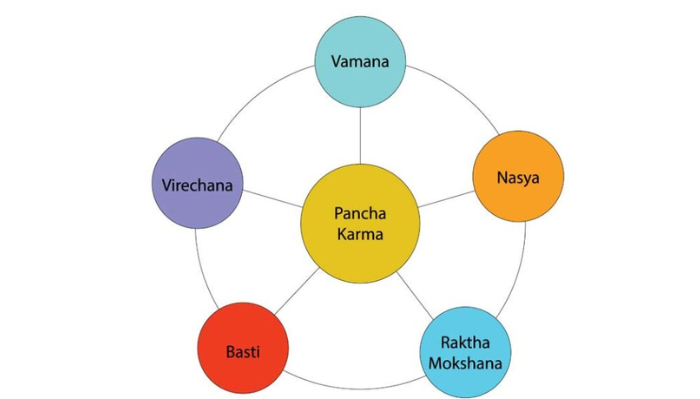
The Classical Panchakarma has 5 techniques specifically designed to eliminate toxins (ama) from the body and restore balance. These techniques are:
Virechana – Once toxins are drawn back to the gut, they leave the body through purgation through purgation. This technique is also the go-to method when Pitta is excessive and needs to be expelled.
Vamana– the body expels toxins through emesis through emesis when excess Kapha accumulates in the chest, head, and sinus areas and needs to be cleared.
Vasti – we remove toxins through Anuvasana Vasti through emesis via enema when there is an excess of Vata in the system. It is a powerful treatment, especially for pain management, degeneration, and hormonal imbalances. Toxins are removed through Anuvasana Vasti(herbal decoction enemas), alternated with Sneha
Vasti – We remove toxins through therapeutic enemas when excess Vata is present in the system. This powerful treatment helps especially with pain management, degeneration, and hormonal imbalances. We alternate Anuvasana Vasti (herbal decoction enemas) with Sneha Vasti (herbal oil enemas) to pacify Vata.
Raktamoksha – The practitioner performs this therapy using medical-grade leeches when Pitta in the blood is involved, particularly in skin conditions.
Nasya – A potent nasal procedure that balances hormones and neurotransmitters, clears sinuses, and builds immunity. The body expels toxins through herbal decoctions or powders, and herbal oils pacify the doshas.
What to Expect After Traditional or Classical Detox
For noticeable results in chronic conditions, 2–3 sessions of Classical Panchakarma are typically needed. However, only one session can be done per year.
Precautions
It cannot be stressed enough — after Classical Panchakarma, allowing 2–3 months for full healing and gradually returning to normal eating is crucial.
EXTERNAL AYURVEDIC THERAPIES [Kairalya Panchakarma]
Practitioners use these therapies for:
-
Symptom management and alleviating discomfort
-
Improving circulation
-
Rejuvenation and relaxation
They may help eliminate some toxins and improve circulation, but they do not address deep-seated toxins the way Classical Panchakarma does.
Who is a Candidate for Kairalya Panchakarma?
It is suitable for individuals who may not be able to undergo the intense cleansing of classical Panchakarma. It’s ideal for:
- People with a weaker constitution or those in advanced age.
- Individuals seeking stress relief, relaxation, or maintenance of health.
- Those who cannot undergo deep detoxification due to certain health conditions or physical limitations.
What to be careful about?
Be proactive—if there’s swelling, inflammation, or toxins, ensure the clinic uses herbal decoctions or powders, not oils, especially for chronic issues.
What is the duration?
The duration typically ranges from 3 to 7 sessions, depending on the severity of the condition. For optimal results, sessions should be spaced on alternate days.
Categories of External Therapies
1. Pain Management
For conditions like back pain, muscle stiffness, frozen shoulder, arthritis, sciatica, etc.
Therapies follow a specific order:
-
Clear blockages with Choorna Pinda Sweda or Dhanyamla Dhara
-
Manage pain with Patra Potali Sweda, Kati Vasti, Janu Vasti, etc.
-
Follow with Navarakizhi (rice bolus) or Royal Oil Bath for degenerative issues
-
Use Pizhichil (Royal Oil Bath) for neurological and degenerative conditions
2. Stress Management
These therapies reduce mental stress, anxiety, and promote emotional balance.
-
Shirodhara, Shirovasti, and Nasya relieve stress
-
Abhyanga balances Vata and promotes lymphatic drainage
-
Royal Oil Bath deeply soothes and rejuvenates
3. Weight Management
-
Udvartana is a dry powdered herbal massage performed in the opposite direction of normal Abhyanga.
4. Maintenance of Sense Organs
- Netra Vasti for dry eyes and floaters.
- Karna Poorna for ear health.
- Nasya for the nose.
- Abhyanga for skin health.
- Gandusha for mouth, gums, and oral cavity. (typically, part of Dinacharya for daily maintenance at home).
Word of Caution
These therapies yield the best results when combined with internal herbs. For chronic problems, Classical Panchakarma remains the most effective approach.
Conclusion:
If you have chronic health problems and need a deep detox then Classical Panchakarma is the way to go, while External Ayurvedic Therpies- i.e. Kairalya Panchakarma for maintaining health, balancing doshas, and providing relief from pain, stress, and fatigue.
Simmi Chopra is a highly accomplished Ayurvedic Practitioner with a unique blend of expertise in traditional Ayurveda and modern science. Trained in the ancient healing system, she completed the prestigious Ayurveda Doctor program from Kerala Ayurveda. Based in New York City, Simmi practices at SIDH Ayur, where she offers personalized Ayurvedic therapies, dietary guidance, lifestyle recommendations, and herbal solutions to help clients achieve holistic balance. Check out her YouTube link – https://youtu.be/5wwBKHj2h1I
Categories
- Categories
- Blog (27)
- Information (62)
- News (7)
Latest Post
- Ayurvedic Treatment for Perimenopause and Menopause Support
- Why Ayurveda Is the Future of Wellness Centers in New York City
- How Ayurveda Helps Nervous System Regulation and Stress Recovery
- Ayurvedic Treatment for Inflammation in NYC | Restore Balance
- Ayurvedic Women’s Health Consultation NYC: A Natural Path to Hormone Balance
- Top Ayurvedic Practices to Boost Immunity